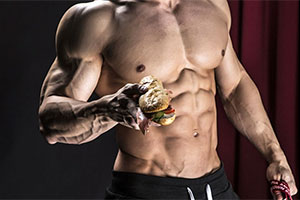
Mark Haub’s Twinkie Weight Loss Diet Works


I just read an follow up article about Mark Haub’s (the nutrition professor from Kansas State University) who is eating mostly junk food on his weight loss diet.

Mark Haub lost 27lbs and his health markers improved.

In summary he’s lost 27lbs in 10 weeks eating some form of junk food (mostly snack cakes you can find at convenience stores).

He is now in a normal body weight category AND his blood markers of health are improving.

This is just more proof that total calories are what matter for weight loss…and that being in a normal/healthy bodyweight range has more to do with ‘health’ than the specific foods you eat to be in that range.

This type of experiment is shows that the type of food really just doesn’t matter when it comes to weight loss. If you want to lose weight, eat foods that you can control and eat less of.

An interesting point he makes is that when he was eating so called ‘healthy foods’ he tended to overeat them.

This is something I’ve noticed that many people do. They somehow think that if a food is categorized or believed to be ‘healthy’ then they can eat as much of that food as they like without gaining weight.

I’m glad Haub’s did this little experiment because the obsessive compulsive health food marketing is getting out of hand and the population need a reality check…

My new weight loss program is going to be built around the principle that the calories are what matter and its up to you to decide what foods you want to eat while you lose weight. This sort of story just further helps with the acceptance of my way of doing it.

You can read his full article here: Twinkie Diet

I’d appreciate if you could comment here on my site.

John

Posted by johnbarban in Weight Loss

33 Responses to “Mark Haub’s Twinkie Weight Loss Diet Works”

  1. Jordan D. Says:

    “If you want to lose weight, eat foods that you can control and eat less of.”

    Exactly. That’s what matters. And ironically, Mark Haub found a way to do that with snack foods! In an article or interview, I forget the exact wording, but he said something about not particularly craving or having a strong preference for snack foods. I don’t think he ate them very much before undergoing this experiment.

    So I have to assume that portion control is less of a challenge for him than for people who have a stronger preference for these foods, or foods like them. (Chocolate donuts anybody?! lol.) It doesn’t seem that challenging for him to stop at one 200-300 calorie portion of a snack food at one sitting. It’s worked incredibly well for him. I bet that there are a lot of jealous people out there!

    As someone with a sweet tooth, I know that this sort of portion control is challenging, but not impossible. I practiced portion control (typically one small-to-medium portion of dessert at a sitting) for about five months before falling off the wagon. So it is possible. And I bet a lot of people would do better on the healthy foods that he overate! So personal differences and preferences play a part, as well.

  2. usernametooshortnowitstoolon Says:

    For most us, Mark Haub’s results are nothing surprising. I’m sure other people, however, will find some other way to rationalize both his fat loss AND improved health markers. I think this all boils down to the fact that the loudest voice tends to be the most persuasive, and whatever good science is out there always gets drowned out by the billions of dollars the fitness and weight loss industries pour into marketing, political lobbying, and propaganda (yes, I said “propaganda”).

    “‘It’s a great reminder for weight loss that calories count,’ she said. ‘Is that the bottom line to being healthy? That’s another story.’”

    I don’t know if it’s THE bottom line, but it’s probably BY FAR the most important thing to being “healthy.”

    “‘There are things we can’t measure,’ said Blatner, questioning how the lack of fruits and vegetables could affect long-term health. ‘How much does that affect the risk for cancer? We can’t measure how diet changes affect our health.’”

    I think this calls to attention the last Adonis podcast. This reminds me of how there may be other nutrients we are not aware of, not to mention the beneficial, albeit non-essential, phytonutrients.

    Imagine if the world focused on diet instead of exercise to lose fat. It would be no exaggeration to say that many of the world’s problems would be alleviated. Take for example, health care costs (both for the consumer and provider side).

  3. usernametooshortnowitstoolon Says:

    “Haub said it’s too early to draw any conclusions about diet.”

    Really? I think John Barban here had it all figured out LONG AGO lol. The results of the experiment were all figured out as well even before it started lol.

  4. usernametooshortnowitstoolon Says:

    LOL @ the comments on that page saying how this is common sense. Well, it’s not for most people; otherwise, CNN wouldn’t deem this newsworthy.

    So I forwarded this article to a bunch of co-workers and friends, and they are all immediately getting defensive. LOL!

  5. tonyoramos1 Says:

    John, I posted this to Facebook and got interesting responses:

    “Hydrogenated oils are killing his heart!”

    “Chemicals increase cancer risk!”

    “Genetically modified foods are doing who knows what to his body and the environment!”

  6. usernametooshortnowitstoolon Says:

    @ tonyoramos1:

    LOL. Well, the first claim was proven false as his blood work indicated. The second and third claims are unproven speculations.

    I hope the second part of the experiment will show that overeating even “healthy” foods will worsen your health markers.

  7. joshua Says:

    not exactly fair to use haub’s experiment as an example of “just eat anything as long as it’s less calories than maintenance and you’ll lose weight.” He took vitamin/mineral supplements, protein supplements, and regular consumption of vegetables. Check out the whole story before buying into the “eat anything as long as it’s less calories than maintenance” bunk.

  8. joshua Says:

    he obviously understood he should have a minimum level of protein to maintain muscle mass

  9. usernametooshortnowitstoolon Says:

    joshua, the vitamins, protein shake, and vegetables were for the nutrients and not for fat loss. A diet of pure 100% junk food is unhealthy.

  10. johnbarban Says:

    Joshua,

    Vitamin supps and a protein shake and some vegetables don’t change the point of his experiment. The article stated that 2/3 of his diet was ‘junk food’. And the point was to show that he could lose weight while consuming mostly ‘junk’ which is what he did.

    JB

  11. joshua Says:

    yeah, I totally agree that one can lose weight eating whatever they want; it IS however important to get enough protein to ensure that weight loss doesnt include too much muscle loss. After all, a healthy, aesthetic body is not just less fat; it’s muscle that gives us our shape. I do agree though, that just losing weight in general can have a profound impact on one’s health (blood markers, insulin sensitivity, inflammation) no matter what is being eaten.

  12. usernametooshortnowitstoolon Says:

    John, do you feel that it’s more of one’s body fat levels OR one’s AI that determines/reflects one’s health? If AI, how does upper body muscle play a role in improving health markers?

  13. mikenavin Says:

    I know when I read an article awhile back on this, it was reported that his health markers (blood pressure, triglycerides, and cholesterol) had all gone up. Which I thought added an interesting point to his experiment: that even though you are losing weight, doesn’t mean you are healthy. But, now that it’s being reported that those levels actually went DOWN, may bring up an even simpler point: that having body fat levels over a certain level has more to do with those health markers than what kinds of foods you are actually consuming. And Joshua, I think you’re putting too much emphasis on protein intake for preserving/gaining muscle mass. If you haven’t already, buy a copy of Pilon’s “How Much Protein” and he gives some great information/studies that show that we really don’t need as much dietary protein that we are lead to believe for muscle preservation/gain.

  14. VGregor Says:

    joshua,
    you will lose muscles only if you stop working out or even moving, not if you cut down on protein. Stop reading fitness magazines man. :)

    John,
    I’ve read few comments on different blogs about this diet, have you also noticed that people always try find what is wrong with it even though he lose fat, it’s supported by research and his health marks gone better? The best comment I’ve seen was something like this: “Yea his fat and bloog presure decreased, but I bet he feels like crap.” Lol, but I honestly can’t remeber where have I seen this one.
    And it’s all based on a one false, but still very strong belief – that junk food makes you fat and unhealthy. I found it very fascinating, how people think, don’t you think?
    VG

  15. johnbarban Says:

    VG,

    Yes I noticed that too. Some people are so fixed into their belief that so called ‘junk food’ MUST be bad for them that they’ll even ignore the fact that someone like Haub who lost weight, and his markers of health improved and that he even says in a video that he feels fine.

    Some people cannot admit that they could be wrong and that any food is ok to eat and that ‘health’ and feeling good is likely almost exclusively a function of bodyweight and has little to do with individual food choices.

    JB

  16. johnbarban Says:

    User,

    The AI measurement is better because having a developed upper body also tells us that you’ve spent considerable time working out and improving your overall muscle mass. It essentially indicates weather or not someone is lean and muscular vs skinny fat.

    JB

  17. Jeff Says:

    This gives me a mixed feeling. I can see how people will take this the wrong way.

  18. johnbarban Says:

    Jeff,

    What would be the ‘wrong’ way to take this?

    JB

  19. trixie28 Says:

    Well Tom V chimed in:http://www.burnthefatblog.com/archives/2010/11/the_twinkie_diet.php
    He seems to be pushing weight loss and fat loss are two different things.

  20. usernametooshortnowitstoolon Says:

    “The macronutrient ratio and nutritional quality of your diet – particularly in combination with training – can affect what kind of weight is lost – fat or muscle.”

    Oh brother. Typical internet B.S. from a typical internet “expert.”

  21. Jeff Says:

    I mean the premise of “That in weight loss, pure calorie counting is what matters most — not the nutritional value of the food” is fine.

    But with the headline, “Twinkie diet helps nutrition professor lose 27 pounds” …after having this information passed along a few times, I can see how people will use this as a justification to eat junk, forgetting completely about the original premise.

  22. usernametooshortnowitstoolon Says:

    Technically, it should be “Low Calorie Diet Helps Nutrition Professor Lose 27 Pounds,” not “Twinkie Diet Help Nutrition Professor Lose 27 Pounds,” haha.

  23. johnbarban Says:

    I think what it does is allows people to stop obsessing about good and bad foods and get to the crux of what really matters for weight loss, which is calories in vs out.

    Fear based marketing has got people to the point where they are afraid to eat the wrong thing and end up literally overeating so called ‘healthy’ food.

    I think Haub is doing a good job of showing people that you can still overdo it with so called healthy food and that you can’t ignore the calories no matter what the food choice is.

    The other point is that it’s impossible to label a food as ‘good’ or ‘bad’ or ‘junk’ or ‘healthy’ without considering the dose and how often the said food is eaten…Haub’s experiment also proves this point.

    People are just messed up about food and need to come back down to earth and realize they can eat a mix of everything including so called ‘junk’ food and still be healthy and maintain a healthy bodyweight.

    I would say that obsessing and stressing about eating a perfect diet free of all the so called evil/bad foods is causing more psychological harm and stress than any benefit it could ever provide.

    No matter what scale or marker you choose to measure (bodyfat, bodyweight, enzyme activity, blood pressure, heart rate, choesterol, lipids, glucose, insulin, inflammation etc) I guarantee you will find it impossible to show that any single food is good or bad without considering it’s dose.

    JB

  24. usernametooshortnowitstoolon Says:

    “The other point is that it’s impossible to label a food as ‘good’ or ‘bad’ or ‘junk’ or ‘healthy’ without considering the dose and how often the said food is eaten…Haub’s experiment also proves this point.”

    This is so critical to note. Really, most people people think that eating a Twinkie is going to give you cancer. They don’t understand that food is just a collection of fats, proteins, fiber, and nutrients. There aren’t any essential food group – only essential nutrients. Just pay attention to calories, eat a variety of vegetables, and if you’re also lifting weights, try to get a daily average of 70-120 grams of protein. It boggles my mind how people refuse to believe it can’t be this simple.

  25. usernametooshortnowitstoolon Says:

    Another great soundbite that needs to be drilled into people’s heads:

    It’s not what you eat, but how much you eat, that matters.

  26. Jeff Says:

    I think counting calories and trying to avoid bad foods can both become stressful and obsessive.

    I forgot where I heard this, but it went something like. “People don’t want to know to eat healthy, they want to how eat healthy at McDonald’s.”

    The way I see it, the problem lies at a much earlier point, their way of thought. People crave instant gratification when they know that they should be watching what they eat or how much they eat. Whether it’s watching for which foods to eat or how many calories they should eat. This guilt only creates more temptation and it leads to a negative spiral. This turns them to look for any justification to indulge without seriously thinking about whether or not it’s actually a good choice.

  27. Jordan D. Says:

    Another thing I like about Haub’s experiment is that it’s pretty much exactly what I want to do! lol. He went from 201 to 174 in ten weeks. I would love to go from 202-205 to about 173-178, and ten weeks would be a great timeframe. If he can do it while eating lots of snack foods, it gives me some hope that I can do it, too.

  28. usernametooshortnowitstoolon Says:

    The thing about snack foods though is they are really calorically dense. That means you’ll never feel satiated/full if you don’t want to go over your caloric allotment. I can see this being doable for a month or so if you’re motivated enough, but I doubt anyone won’t crack after that.

  29. Jordan D. Says:

    Username, I misspoke. I didn’t mean to imply that I want to duplicate his diet exactly. I meant that it gives me a hope that I can lose roughly the same amount of weight in roughly the same amount of time. If he can do it while eating lots of snack foods, I can do it while eating whatever I choose to eat. I couldn’t eat exactly the way that he does, if for no other reason than the lack of fiber! Seriously, how does he get away with that?! lol.

    You wrote, “I doubt anyone won’t crack after that.” Well, Haub kept at it for ten weeks, so that’s at least one person who didn’t crack after a month! lol. As far as satiety goes, I doubt that would be an issue for me. I ate my version of a low calorie/ low volume diet for five months before cracking. I did fall off the wagon eventually, but five months is a pretty long time. I probably could eat a diet similar to Haub’s if I really wanted to, but I don’t really want to, to be honest.

    But I’m not convinced that satiety is the real issue here. Overeating can occur without a lack of satiety. People eat, and overeat, for lots of different reasons, many of which have little or nothing to do with physiology. As I mentioned in my previous comment, he said that he doesn’t have a strong preference for those foods, so that’s probably helped him in terms of portion control. That’s the real issue, for me and many others. Portion control.

    I can eat several hundred calories of a “healthy” food like chili, or an “unhealthy” food like ice cream. It doesn’t matter much to me. A delicious food is a delicious food. I believe that it’s more about taste than processing, macro’s, micro’s, insulin, etc. Yes, processing can create and enhance flavors, so can adding fat, sugar, salt, sauces, etc. But it still boils down to calorie content and flavor, IMHO.

  30. incleish Says:

    Hey John,
    Every time in the past where I’ve cut calories I’ve noticed a decrease in libido. First, is this normal and secondly, if not I’m wondering if it’s more due to too much training volume on too little calories causing the problem. In the past I’ve typically included sprints, hill runs, etc for 20-30 min 4xwk on top of my usual 4xweek lifting schedule. I’m experimenting this time w/no extra work on top of lifting and keeping cals to 1500/day M-F, 2000 saturday and 3000 sunday (so I can have something I like). Feeling good so far….

  31. johnbarban Says:

    Incleish,

    I haven’t looked in the research for this specific effect (lack of libido) with calorie restriction but that is something I’ll look into. Honestly at this time I can’t comment any further as I have never investigated it.

    JB

  32. alowry Says:

    I disagree with calling this an ‘experiment’. It is a demonstration or exercise but lacks the controls etc. to be an experiment. To call it that, which many do, I think just confuses folks as to what an experiment involves and increases their science ignorance.

    Still I like the message that it gives, ‘it’s the calories stupid!’

    Regarding libido I have had the opposite effect. ESE and lifting increases my libido. A curse more than a blessing since I travel a lot on business.

  33. To metabolize or not! « Workin' it at Work Says:

    [...] don’t store as much and it doesn’t become fat over time. My favorite example is the Twinkie Weight Loss guy. It proves that reducing your calorie intake is the fastest way to lose [...]

Leave a Reply

XHTML: You can use these tags: <a href="" title=""> <abbr title=""> <acronym title=""> <b> <blockquote cite=""> <cite> <code> <del datetime=""> <em> <i> <q cite=""> <strike> <strong>