Build Muscle in the Gym – Lose Fat With Your Diet


As far as I’m concerned the gym is mostly (if not entirely) meant for building muscle. Sure you can do some ‘cardio’ there and try to burn a few extra calories, but I think the bulk of your time in the gym should be spent building muscle (that includes women too)

Muscle Building Happens in the Gym

Muscle Building Happens In The Gym

I think many people run into a problem trying to make their workouts do more than they really can. For example the other day I was at the gym and saw a personal trainer making her client push a sled (loaded with 150lbs of weight) back and forth across the entire length of our gym (about 30 yards).

The poor guy pushing the sled must have been at least 70lbs overweight and I’ll bet he is hoping that these workouts are going to somehow make him lose weight.

This is a perfect example of having the wrong expectations. If that guy doesn’t start revamping how much he eats (aka eat less) then all the sled pushing in the world isn’t going to cause him to lose any weight.

It just seems like a lot of wasted effort because pushing that sled around isn’t even building his muscles in a way that will look good when he finally does (if ever) lose the weight.

The point is not to mix up what your diet and your exercise can do.

Use the gym primarily for building muscles and use your diet for weight loss.

IF you don’t have much bodyfat to lose (ie: you’re in that last 10lbs range) then you can certainly accelerate the process in the gym…but it’s still dependent on keep your calories in check.

The bottom line is to stick with a consistent workout for building muscle and use your diet to lose bodyfat.

John

Posted by johnbarban in Fat Loss, Muscle Building

How Do Muscles Grow?


The specifics of muscles growth are not well understood yet.

Yesterdays discussion brought up some questions about the specifics of muscle growth. It seems there is some confusion on what muscle growth even is.

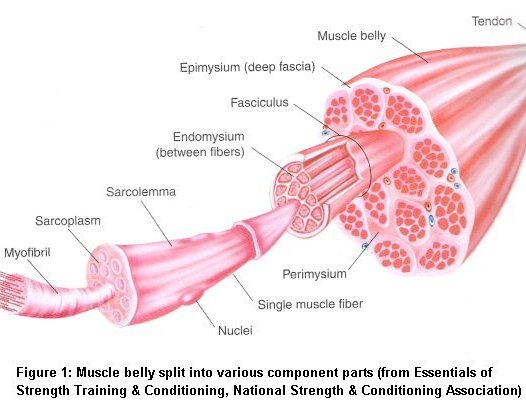
To understand muscle growth we have to first understand what a muscle is made up of.

Skeletal muscles are somewhere in the neighborhood of 80-85% water, this is the fluid that makes up the cytoplasm of each cell. The rest of the structure is a mix of protein and lipids and some carbohydrates.

Glycogen is stored in the muscles as well as some amount of amino acid pool that is in a constant state of flux.

Glycogen is stored in approx a 1-2 ratio with water; for ever gram of glycogen the muscle can store it also needs to store two grams of water. Each gram of muscle protein also seems to require approx 2 grams of water.

The transient states of exercise, or even day to day activity are what determine if your muscles will grow or atrophy. In other words, it’s incomplete to assume your muscles have a standard size.

A more accurate view would be say: How big are you muscles when they are:

A) complete inactive in a cast

B) active from day to day activity but no purposeful weight training

C) stimulated from regular weight training

D) stimulated from drug use (testosterone and GH etc)

E) stimulated from supplement use (creatine, BCAA’s etc)

F) Some combination of the above

Each one of these stimulus (or lack thereof) combined with your genetic predisposition for a baseline of muscle fibers will determine how ‘big’ your muscles are given the state they are in.

The specifics of what even makes a muscle bigger and smaller is still unclear. Some research points to sarcolemma growth while other research suggest sarcomere growth, and still others are assuming both happen along with some degree of hyperplasia and potential fiber splitting.

In any case the size of a muscle is dependent upon a transient state of stimulus. Take the stimulus away and the muscle will atrophy, add more stimulus in and it will hypertrophy, but there are always limits to both ends of the spectrum.

John

Posted by johnbarban in Muscle Building

HeavyWeights Weren’t Always Heavy


Keeping with the them from yesterday post here is some interesting information about the heavyweight division in boxing.

The Best Heavyweight ever!

In 1920 the heavyweight division had a minimum weight imposed of 175lbs (that doesn’t sound very heavy to me)

Currently the heavyweight division starts at 200lbs and has no upper limit.

If you look at the fighters in the heavyweight division you’ll see that they’re much taller than the other divisions.

In other words, weight is most closely associated with height. If you’re not at least 6’0 feet tall, it is highly unlikely you can be 200lbs and lean (without drugs).

Muhammad Ali is approx 6’3 and his fighting weight is listed anywhere from 188-236lbs

The reality is that most guys aren’t as tall as Ali and most guys will never be as heavy as Ali, but for some reason when young guys start working out they always set a bodyweight gain goal (I know I did). Many young guys set 200lbs as one of their body weight goals no matter what their height is.

This is the wrong way to go about goal setting because the amount of lean mass you can carry is determined by your height.

This doesn’t mean you can’t look good at your height, it just means you shouldn’t bother using weight gain as a way to measure progress.

Probably better to find a role model physique/body of a person who is the same height as you (and preferably somatotype as well) rather than picking some arbitrary bodyweight you think you should hit.

John

Posted by johnbarban in Muscle Building

Does Muscle Gain Equal Weight Gain?


Bodybuilding magazines and supplement marketers will have you believe you can gain a significant amount of muscle mass that will cause your bodyweight to increase simply by working out and eating some special foods/supplements.

Big, Strong, FAT!

If you re-read that sentence the key point is the difference between gaining MUSCLE vs gaining WEIGHT.

Adding muscle to your body doesn’t necessarily mean adding a significant amount of weight.

If if were true that constantly working out with increasingly heavier weights caused you to gain bodyweight there would be no such thing as weight classes in power lifting or olympic lifting.

In other words, if everyone worked out enough and gained enough weight wouldn’t everyone be in the heavyweight category?

Or is the truth that the degree of muscle mass we can carry is limited by our height and somatotype and no matter how much we workout we’ll level off at a very predictable bodyweight for our given height.

To review, here are the weight classes for olympic weight lifting and power lifting. All classes have competitors of similar training experience and age…this is good proof that there are tight limits to the size any of us can get to.

Olympic lifting weight classes for men:

56 kg (123 lb), 62 kg (137 lb), 69 kg (152 lb), 77 kg (170 lb), 85 kg (187 lb), 94 kg (207 lb), 105 kg (231 lb), and over 105 kg;

Power lifting weight classes for men:

Men: 52kg, 56kg, 60kg, 67.5kg, 75kg, 82.5kg, 90kg, 100kg, 110kg, 125kg, 125kg +

The heavier competitors are typically taller and fatter than the lighter ones.

This is also why bodyweight is a rather useless indicator of muscle size.

John

Posted by johnbarban in Muscle Building

Steroids – How Serious Are You About Being Big?


It seems that many guys who are trying to build bigger muscles and ‘bulk up’ really don’t know what they’re talking about and don’t even know what it is that they want. I think any statement about building bigger muscles or bulking up needs to be qualified.

Deca Durabolin

If you hear a guy say: “I want to bulk up and put on muscle” what he should be saying is: “I want to bulk up and put on as much muscle as possible without using steroids”

The qualification of steroid use or not dramatically changes what “bulk up” and “put on muscle” even means.

And this is where the breakdown occurs between many guys expectation of how much muscle they think they can build vs what they actually experience.

Many novice, intermediate and even some advanced lifters are reading magazines and taking supplements but looking at pictures and idolizing athletes and bodybuilders who all take steroids. The false assumption is that you can get steroid like gains without using steroids.

So the following two lists are the priority lists, thoughts and decisions that go through the head of two different guys: one who does and one who doesn’t use steroids:

Guy who uses steroids

1. I want to get as big as possible

2. I want to get as strong as possible

3. I’ll take whatever drugs get the job done

Guy who doesn’t use steroids

1. I want to be as big as possible without drugs

2. I want to be as strong as possible without drugs

3. I’m scared of drugs and want to recreate drug like gains without using them

4. I’ll try to recreate drug like gains with supplements

5.  I’m worried what others will think of me if I use drugs

6. I’m still really scared about side effects

7. I’ve been training for years and still can’t grow as fast as ‘big guys’

I must need more protein and supplements

8. I’m scared of drugs and their side effects

9. I must not be eating enough to gain like the ‘big guys’ so I’ll eat more

10. There must be some special workout technique I’m missing that will make me gain muscle faster so I will subscribe to dozens of ‘muscle building’ newsletters

11. I’m scared of drugs and their side effects.

And thats it. That is the real difference between guys who do what it takes to be really big, and guys who think they want to be that big.

I’m not saying that every guy who lifts weights must use steroids. What I am saying is that if your goal is steroid like size, then the only way to achieve it is with steroids. <– this seems pretty obvious.

Many of the muscle building and strength building marketing that you see uses models, bodybuilders and athletes who are using drugs. And you as the reader end up believing that a special workout or supplement can give you the gains that only drugs can produce. Eventually you blame yourself for lousy genetics, not enough protein in your diet, the wrong supplement routine or simply not pushing hard enough in the gym. All of these things are false.

The real problem was setting an unattainable goal in the first place. (this preys on the male body dysmorphia complex that we all have even slight twinges of: the need to be bigger and stronger than the next guy over)

Until the fitness/nutrition/diet/supplement industry lets you in on the secret that all of their models use drugs, you will always be left guessing and wondering what amount of muscle size and conditioning is truly possible without them.

John

Posted by johnbarban in Muscle Building, steroids